Pages

Showing posts with label From the Eyes of an Expat. Show all posts

Tuesday, October 10, 2017

A Little Encouragement for Those Trips Home


I spent a few weeks this summer getting my girls settled in school and visiting friends and family. The few precious moments at home are filled with obligations, wants and needs. There are people to see, doctor's appointments to do and shopping to accomplish. Sorting it all out is like untangling a box of fishing lures. It's exhausting before, during and after the trip. Every expat that I've talked to goes through this, whether missionary, diplomat or other. 

I struggle with finding the correct balance every single time. I've done trips home with specific purpose and other trips where I have a more flexible schedule and freedom to spend time with people. We've lived out of suitcases moving from home to home every few nights, spent a month in a camper, and stayed with friends. Each option has its pros and cons and meets different needs. By far, the best trip home was staying in the camper. It gave us our own space to decompress each day with unlimited freedom to make our own schedule. Each evening we made a bonfire and unwound with a book or conversation and few roasted marshmallows. 

I think Paul from the New Testament was a bit like me. He moved around a lot. A group of friends  traveled with him from time to time, but he didn't seem to have a home to go to. He didn't return to the same place every summer to blow the dust off the cabinets, settle in and enjoy lazy days. His things were scattered across creation, stuck in the corners of friends' homes until he returned to use them again. There were the things he wished he'd brought with him as well–scrolls and cloaks that he needed in his daily life. He had times of loneliness and opposition. In all my travels, I haven't met an expat yet that lives as out of a suitcase as Paul seemed to do. I have it easy, yet I struggle with the returning home aspect that a transient life brings.

I'm also like Paul because I'm a communicator. Paul was always developing relationships, writing letters and encouraging the church. I don't write to churches, sending out encouragement, but just like Paul had his tribe of Priscilla, Aquila, Mark and Titus, I also have my little tribe of friends that I stay in touch with and long to see in my travels.

Since this last trip home, I've thought a lot about Paul's words in his letter to the Romans: "I long to see you so that I may impart to you some spiritual gift to make you strong–that is, that you and I may be mutually encouraged by each other's faith." (1:11-12) 

Paul had a pretty specific goal in wanting to see his friends. It was a little give and take; he needed encouragement and he wanted to give encouragement. I love how honest he is about this. He was ok in saying "I need you, my tribe, to come alongside me and give me a boost of encouragement." He got that his friends needed a boost of encouragement in their lives too. Life is hard. We all have work day in and day out that we do. We encounter situations that are difficult and we have to wrestle through how to react to them. We can't do it alone, we need other Christians along side us to talk to and figure these things out together. We need some cheerleaders on the sidelines screaming "You can do it!" Paul needed to see his friends doing the daily life and choosing to live it God's way. He needed that sort of encouragement so that when people tried to kill him, he knew that he wasn't the only one choosing to live for God. 

This gives me a little focus as I think about home. I know that some relationships are going to fade. I don't live there anymore and I can't hold onto every single one. But how am I choosing the relationships that I do keep? Are they mutually encouraging? Are they a little give and take? Honestly, it's very easy to have the mindset when I'm home of take, take, take. I need rest. I need to talk to you, I need to go to this store... The list of "I needs" is endless. So how can I balance this? 

I would love to hear from you. Whether you moved 100 miles or 10,000 miles, how do you balance needs and relationships when you are home? How do you give and take? Do you return back to your place of living worn out and exhausted or encouraged and rested?

Monday, June 6, 2016

Ruth - From the Eyes of an Expat - 4:11-15


It's time to wrap-up the book of Ruth.  I didn't expect to write all these posts, but the story just came alive, deep with new meaning that was bursting out, wanting to be told.  It's been an amazing journey with this group of women.  I've watched the Bible come alive to them as well.  Different characters in the story resonated with each of us.  We've grown from our discussion and time together.  I've watched white, crips pages in their Bibles become covered in notes.  Circles and arrows now fill the margins recording moments of understanding and revelation.

The final chapter found me marveling over the five blessings, each unique and individual to the person to whom it is intended.

1.  A blessing for Ruth from the elders of the town.  How appropriate that the leaders in the town recognize the character of this foreigner amongst them.  Their declaration moves Ruth from being an outsider to being an important thread in the lineage of their future king.  "May the LORD make the woman who is coming into your home like Rachel and Leah, who together built up the house of Israel."  How did the sisters, Rachel and Leah, the wives of Jacob, build up the house of Israel?  They are the mothers of the 12 sons who each became a tribe of Israel.  How did Ruth fulfill this prophesy?  She became the great grandmother of King David and is in the lineage of Jesus.  

2.  A blessing for Boaz from the elders of the town.  Standing and fame.  "May you have standing in Ephrathah and be famous in Bethlehem."  I don't think Boaz was looking for either of these things.  He already had a good reputation and standing because of his financial status and the way he treated people.  He became famous because God chose that his name should be remembered in the lineage of Christ. 

3.  A blessing for Boaz's family from the elders of the town.  "Through the offspring the LORD gives you by this young woman, may your family be like that of Perez, whom Tamar bore to Judah."    This seems like an odd blessing to me.  This is the story of Tamar, who dressed as a prostitute to seduce her father-in-law, Judah, because he would not give his last son to her to carry on the family inheritance.  She had twins, and Perez was the first born.  He became the head of a leading tribe in the land.  These are names I'm not very familiar with, but to the people of Israel, this blessing was common.  It was a blessing to be honorable and numerous just as Perez was.

4.  A blessing for Naomi from the women.  How beautiful that Naomi, who returned to her people bitter and with no hope, is blessed by the women of the town.    I'm sure these women had watched Naomi mourn and then slowly grow hope as she resettled in Bethlehem.  Ruth marries and has a child.  Now the women surround her with love and encouragement.  "Praise be to the LORD, who this day has not left you without a kinsman-redeemer...  He will renew your life and sustain you in your old age..."  Renewed life and sustenance.  This is what Naomi needed, a new life.  This is the beautiful picture the kinsman-redeemer gives.  Just as he provided Naomi new life, Jesus provides us new life.

5.  A blessing for Obed from the women.  This wee child was given a great blessing.  "May he become famous throughout Israel!"  Future grandfather to King David and in the lineage of Christ, his name is recorded for all to know.

I hope the book of Ruth has come alive with new meaning and deeper understanding.  I've enjoyed this time, writing my thoughts and sharing what I've been learning.  Thank you for coming on this journey with me. 

Monday, May 30, 2016

Ruth - From the Eyes of an Expat - 4:6


I was afraid I wasn't going to have anything to blog about chapter 4.  Nothing stirred my soul when I read it.  The story felt complete, but I didn't find anything new and noteworthy.  Then our group met.  I learned so much.  I was inspired.  I was stretched.  I changed.  This is what I love about studying the Bible with other women.  It changes you.  You can't say that about a book club--and  I enjoy book clubs.  You can have a great time with friends discussing the same book.  You can change your opinions, but you don't walk away, week after week, a better person because of the time you spent with a group of women.  When you study the Bible together, you grow a bond of trust and understanding.  You become vulnerable.  You are willing to say, "I don't understand" and you are willing to be taught.  It's simply beautiful.

I have a bit of prejudice against this kinsman redeemer who is first in line for Ruth.  Ruth sounds like an amazing catch to me--who wouldn't want her in his life?  But this man didn't.  I don't get it.  When the man turns Ruth down because he might endanger his own estate, I could only explain it by deciding that he must be married.  But that doesn't make sense either and there really is no indication of this.  So I approached our group and said I just didn't understand.  Then one of the girls who is Colombian commented that in her culture, things were different.  Family stuck with family.  Family trumped marriage.  I lived in Colombia.  I could see what she was talking about.  The family ties were stronger.  Then another woman spoke up.  Her in laws are Chinese, living in China.  She said that the family loyalty was stronger than even marriage.  I began to think about what I have encountered here in Taiwan.  From the women in my first Bible study to the women at work, I have picked up on this order to life where the in laws dictate your life.  Care of parents is paramount.  My friends hate holidays because they do all the work.  I mean all the cooking, all the cleaning, all the hosting.  It is the daughter-in-laws job to be the servant of all.  This is mind baffling to me and something that I can't quiet grasp, even though I watch it going on around me.

In this kinsman redeemers mind were the strong bonds of loyalty to his family.  If he died and only had one child by Ruth, he did not want all of his earthly possessions to go to Naomi's family as the redeemer price.  All this man could see were the things.  The tangible elements that are passed from generation to generation.  Boaz had a different perspective.  Boaz looked at the person, not the possessions.  Boaz was willing to risk things to help a woman.  Boaz may have had more at risk than kinsman redeemer number one, but because he put his focus on people and not things, God blessed him.  Kinsman redeemer gave up so much by not taking Ruth as his bride.  We don't even know his name, just the fact that he turned down the opportunity to be in the line of the Messiah.

What blessings are things stopping you from?  It's easy to loose our focus on those around us and to only care about things.  But as soon as we do that, we are missing on so much more.

Monday, May 23, 2016

Ruth - From the Eyes of an Expat - 3:11


"All the people of my town
know that you are a
woman of noble character."
Ruth 3:11

What a beautiful reputation to have!  Can you imagine people who have come in contact with you saying you have "noble character"?  (Or as the King James version puts it, "a woman of virtue.") As I travel the world and come in contact with all these people who have predetermined ideas based on the media and Hollywood of what an American is, do I change their minds?  What about people who have preconceived ideas of what a Christian is?  Do they think "noble character" when they get to know me?  This is another one of those awesome little discoveries in the book of Ruth.  

I can imagine the prophet, Samuel, writing the account of Ruth.  Possibly he sat down with Jesse, the father of King David, and listened to him tell stories of his grandmother.  Jesse probably reminisced about the grandmother he knew and the family story that had been passed down about how his grandmother came to Israel and how she met his grandfather, Boaz.  Samuel probably found this story fun and inspiring to record.  As he listened to Jesse, the phrase "a woman of noble character" could have run through his mind until he chose those words to write down as an everlasting description of this foreign woman who would become the great grandmother of King David and mentioned in the genealogy of Jesus.

The only other place in the Old Testament that we find this phrase is in Proverbs 31.  Yes!  The chapter we all turn to when we want to have a bit of guidance on the sort of women we are to be, the "Woman of Virtue" chapter.  The book of Proverbs was written by the wise King Solomon.  (I know that chapter 31 begins by saying this is from King Lemuel, but in my research, many scholars strongly feel that this is a reference to Solomon.  Another possibility is that Solomon is writing once again here because vrs. 10 is the beginning of acrostic poem.  So, I am going to assume that Solomon is the author of this section on the virtuous woman.)  Ruth was Solomon's great, great grandmother.  This is so exciting, it just gives me chills!  By using this phrase that would have been familiar to the people, it's as if Solomon is saying, "You want to know what a virtuous woman is like?  Look at my great, great grandmother, Ruth."  As I read through Proverbs 31, I see glimpses of the girl Ruth, who earned a solid reputation in such a short time in Israel.  She brings him good, not harm,  (vrs. 12) works with eager hands.  (vrs. 13) she gets up while it is still dark; she provides food for her family (vrs. 15) She sets about her work vigorously; (vrs. 17) She opens her arms to the poor and extends her hands to the needy. (vrs. 20) Her husband is respected at the city gate, (vrs. 23) She is clothed with strength and dignity; she can laugh at the days to come. (vrs. 25)  All of these phrases remind me of the girl Ruth, I have studied.  And then my favorite part.

Charm is deceptive, 
and beauty is fleeting:
but a woman who fears the LORD is to be praised.
Proverbs 31:30

Ruth, the girl from Moab, who turned to her mother-in-law and said, your God will be my God, left all of her former religion behind, and with her whole heart, embraced the one true God.  She passed the truths of who God is down to her children, and they to their children until a king, sitting on the throne, picks up a pen and begins to write about his great, great grandmother and says "This is what you want to be like."  As she grew into a woman, these characteristics grew and matured into being a solid woman of virtue.

Her children arise and call her blessed;
her husband also,
and he praises her:
Many women do noble things,
but you surpass them all.
Proverbs 31:28-29

Monday, May 16, 2016

Ruth - From the Eyes of an Expat - 3:9


Language is a crazy thing.  We string random words together that don't make any sense, but because we understand the idiom, we give no second thought to saying something like "Don't do that, you'll just open a can of worms."

I'm having a great time in my office teaching some of the local staff these phrases.  In fact, sometimes I even try to add them to our conversations just to have a bit of a laugh together.  "I'll get to that in the drop of a hat." or "You just hit the nail on the head."  We discuss the meaning, then throughout the day the girls will try it on me a few times, I google the definition and send it to them with a cute clip art to give a visual clue.  We have great fun with this.

In return, they explain Chinese sayings to me and play on words in their language and culture.  The Lunar New Year is probably the most important holiday in Taiwan and food is an important part of the festivities.  Certain foods are given as gifts simply because of the way the name sounds.  For example, the word for the fruit persimmon is pronounced shi in Mandarin which suggests the expression shi shi ru yi (may everything happen as you wish).  Rice cakes are popular, especially one called fa gao.  Fa means to make plenty of money. Giving these treats wishes good luck on those you bestow them to.

It's also easy to think that because I speak English, I will understand the language in other English speaking countries.  When moved to New Zealand, we quickly learned that English was different all over the world.  We would giggle as we said we were wearing our jandals (flip flops) and togs (swimsuits) to the bach (beach house).  When we first arrived, we had no idea what that sentence even meant!

Languages have layers and hidden meanings and sometimes you have to understand more than just individual words on a page to be able to get the rich meaning of a story.  This is one of the things I love about studying the Bible.  There are the black and white words right in front of me that I can read and understand.  The book of Ruth tells a story.  It's simple, about a woman and a girl and a man.  When I read this book in the context of the other 65 books in the Bible, I discover another layer that tells a greater story about the redemption of God.  Then as I dig deep, I begin to uncover little pearls and gems hidden within the text.

Today my discovery is one of those pearls.  This idea that Naomi sent Ruth to Boaz in the dark of night, told her to wait until he had drank his fill of wine, and then to approach him and lay down at his feet sounds risqué and crazy.  In fact, it was.  But in all my searching, I did not find any source that accused Boaz and Ruth of being impure.  Quite the opposite, this daring act forced Boaz to protect Ruth and her reputation.

I took some time to read the chapter in the Message translation.  I actually didn't like the way the story went.  If felt a bit unfamiliar and unsettling so I set it aside and began to dig into a few verses.  When I came to verse 9, I was taken by surprise.  This little scene that I am so familiar with "Spread the corner of your garment over me..." is much deeper than just Ruth being a bit chilly and wanting Boaz to lay his coat on her.  The Message says "Take me under your protecting wing."  Wow, that's different!  My mind was jolted to 2:12 because our group found it so beautiful that Boaz blessed Ruth by saying "May you be richly rewarded by the LORD, the God of Israel, under whose wings you have come to take refuge."  The same Hebrew word is used in both these verses.  Kanaph is translated so many different ways:  corner of your garment (NIV); corner of your covering (NLT); your covering (NASB); spread therefore thy skirt (KJV); spread your cloak (HCSB); marry your servant (NET); edge of thy mantle (Jubilee); spread thy coverlet (Douai-Rheims).  Do you see how confusing this can become?  In fact, only the Message and the ESV translations used the word wings in vrs. 9.  The exact, precise meaning of the word Kanaph is wing or extremity.  How cool is this?  I think we have a little romantic banter going on here.  Boaz asked God to spread His wings over Ruth and she replied, "How about you spread your wings over me?"  Ruth was asking him to protect her.

This is where studying the Bible gets fun.  The phrase "to spread his wings" also means to spread the outer four-fringed garment over her as is still done in Jewish wedding ceremonies today.

This whole exchange was bold and daring as well as fun and playful.  It makes me fall in love with the story of Ruth all over again.

Monday, May 9, 2016

Ruth - From the Eyes of an Expat - Chapter 3


I used to think of the book of Ruth as a love story, and it is, but not quite yet.  Chapter 3 begins to touch on what will be love, but at this point, it's a story of trust, of obedience,  and of respect.

I used to have a hard time with the idea of Ruth marrying this man that she didn't know.  That was when I was young and newly in love myself.  The concept of a marriage that worked, and worked well, between two people who didn't know each other was something that I just couldn't grasp.

While my husband and I were dating, I got to know one of his friends pretty well.  Our friend was Indian.  We sometimes ate dinner together in the cafeteria.  We went to church together and grew to a place where we were comfortable talking.  I remember asking him if there were any girls he was interested in.  He said no, his parents had a girl promised for him in India.  He never went on a date - ever.  Several years after Chad and I got married we bumped into our friend and he told us he had just gotten married.  He was so happy.  In the following years, we got together occasionally and watched as their family grew.  They were a couple who were happy, serving God together, growing a family and in love--and they only met once, briefly before they walked down the aisle and said I do.

Watching that relationship grow was the beginning of my understanding that love could develop in a different way than my western mind understood.  But our Indian friends were young and of the same age and culture.  Ruth and Boaz had more to overcome than simply not knowing one another.

Another hurdle in my mind was the age difference between Ruth and Boaz.  There are enough mentions in chapters one and two that Boaz is old and Ruth is young to know it was significant.  I have no idea the difference in age, but the picture that comes to my mind is one that is tainted by Hollywood and money.

Too often is the picture one of an old man who is filthy rich with a piece of eye candy on his arm.  You know she's just in it for the money and he's just in it for what others see.  Rarely does it work out.  These stories are just one disaster after another.

When I worked at the embassy in Moscow, I began to get to know several of the older men who worked as contractors in the facilities' department.  Because of the high security needed in Russia, the embassy could not hire locals to do tasks such as cleaning the office space or fixing broken things.  So contractors from America with high level clearances, lived in Moscow, just as we did, and worked for the US embassy taking care of the necessary every day tasks that needed to be done.  Often these were men and women nearing retirement, or who had retired from one job already and were doing this as a way to see the world and save up some extra income.

It is typical when working for the embassy to hire a maid.  In Moscow, the majority of the maids were from the Philippines.  They worked long days and sent the majority of the money they made back to the the Philippines to support their greater family.  I met several men who had recently married their maid.  The first couple I met, startled me.  I had a bit of a hard time understanding the relationship.  I began to watch these couples, how they interacted.  I wanted to know if they really loved each other or what the attraction was.    Slowly, I began to see and understand a very deep love between the men and women.  For the men, they now had someone to take care of and to share meals and conversation with.  For the women, they had suddenly had someone to provide for them and they had someone to take care of.  These couples tended to be very caring and compassionate for one another.  Their love was built out of meeting needs for the other person.

This second picture, the couples in  Moscow, give me a glimpse into the relationship that Ruth and Boaz may have had.  Both people had built a reputation to be respected.  They had common ground of a firm belief in the one true God.  Ruth needed a redeemer, someone to care for her and carry on her dead husband's name.  Boaz gained companionship and someone to care for.  Their relationship started out based on respect and duty, but by the end of chapter three, I think we begin to see some love shining through.

Monday, May 2, 2016

Ruth - From the Eyes of an Expat - 2:12


I haven't always lived an expat life of moving from country to country.  I used to live in a cozy little neighborhood in America.  I went to the local grocery store where everything was familiar.  I took my kids to the park around the corner where we frolicked in the sun.  I hung out at my neighbor's house where we shared cookies and coffee and commiserated over life.  I knew her and she knew me.  We shared a common culture which allowed the relationship to blossom overnight into a lifetime friendship.  We had a foundation of understanding because the world that had shaped us was similar.  The government was the same.  We shared the same language and even accent.  We shared the same religious background.  

Another neighbor moved in on our street.  He was not from America.  We also built a wonderful relationship.  This relationship was built on sharing and learning from one another.  Hearing about the new was a channel that flowed into more conversation.  I was the local and he was the foreigner in my country.  At that point I had a more limited experience of living outside the United States so I didn't have a personal experience of being a foreigner to base my approach on.  Our time together sort of just flowed from my gut desire to help him adjust to and enjoy his new country.
In this time of studying Ruth, I've been focused on how Ruth felt and acted as the foreigner.  I've had a new respect for her and her circumstances.  In my Bible study this week, one woman pointed out the amazing way that Boaz treated Ruth, the foreigner.  Boaz blessed Ruth.  I think this was a bit of a shocking concept of the time.  I think it's a bit of a shocking concept for our time.  The general tone I hear is that we don't want to bless those who come to our country to find a better life.  We fear the foreigner.  We fear those whom we don't understand.  Whether they come as illegal immigrants or refugees, Americans don't want them in our country.  

I remember one day many years ago.  I was having lunch in my very white suburb and two Asian ladies were having lunch at a nearby table.  They were speaking in Chinese.  I remember thinking how different they were from everyone else in the room.  I wonder how hard it was for them to get to know their neighbors?  I wonder if they felt lonely and isolated?  I wonder if they tried going to a church, were they accepted?  

Now that I have lived this lifestyle for awhile, I really believe it is a good thing for all people to take time and live outside of their home country for awhile.  If you can swing it, I suggest a minimum of a year.  It changes how you see other people.  There's a difference between living in a foreign country and visiting a foreign country.  Of course it's good to visit other places around the world.  The experiences will begin to change you, but when you work and live life along side people from another country, you have the time to really learn.  You can ask questions and discuss differences in the ways to do things.  As you begin to open up your mind to simple differences that don't hugely impact life, you begin to be more gracious in the differences.  Because when it comes down to it, God wants us to be able to look at a person's heart and see them, not by the color of their skin or where they are from, but on who they are.


Monday, April 25, 2016

Ruth - From the Eyes of an Expat; 2:10


The humility of Ruth bewilders me.  Not because it doesn't make sense, considering her position and that she knows little of this foreign country, but because it's not the attitude I see displayed in expats today.  It's something I try to evaluate from time to time and I think all expats need to take some time to think about how they treat nationals from their host country.  

Plenty of times I've been shocked and embarrassed as attitudes of entitlement seep into interactions when I'm in a group of people.  "Why do they do it that way?" or "Our way of doing this is so much better." are common phrases I hear repeated over and over. 

Sure, it's easy to fall into that trap.  Something as simple as queueing in line at the grocery store can be absolutely infuriating, but in the end, it all works out.  When all we know and is familiar is stripped away, our patience wears thin and it's easy to want things done in a way that is comfortable.  

Ruth certainly was in an uncomfortable and awkward place.  People were talking about her, she may have been stared at as she walked down the street.  But she didn't let these things change her.  I see people change after they have lived overseas for awhile.  Often they become rough around the edges. They loose the concept of politeness and become the obnoxious American we all dread.  Even when around others from their own country, they obsess about the latest situation in which they felt uncomfortable.

If you are living in a country that is not your own, take some time to do some deep soul examining.  How are you treating the people in your host country that you come in contact with?  What sort of reputation do you have amongst the nationals in your country? Has your time overseas hardened you with anger, entitlement and bitterness?


Monday, April 18, 2016

Ruth - From the Eyes of an Expat - 2:7


Like every little girl, I would imagine that Ruth played dress-up or put together imaginary stories in her mind of what life would be like someday.  While she was running around with the other little girls in Moab, I'm sure that she never played the part of the poor widow in a foreign country who followed along behind the servants, picking up the bits of looked-over grain so that she could eat a meal that day.  

Ruth's dreams had been broken, but I never see Ruth wallow.  I know I like to wallow.  When things don't go my way, I take a bit of time to sit in the middle of my mud puddle and shed a few tears--especially when I am far away from home and feeling very alone in a foreign land.  But despite her circumstances, Ruth worked hard and quickly built a reputation of someone who was worthy.

Let's face it, life is hard.  There are times of joy and rest, but the majority of life is hard work.  It's all those times between the fun that really show who we are.  It's the everyday mundane that people see. They see our faces, listen to our words and watch our actions.  Day in and day out, we are building a reputation for ourselves.  Then in the mundane a crisis will happen.  There are always crises, big ones and little ones.  In the midst of crises, we find out what we are really made of.  

Ruth was made of gold.  She had made a verbal commitment to her mother-in-law to follow her and follow her God and now Ruth is going beyond that promise and not just following, but providing.  God saw Ruth and blessed her.  That day, Boaz noticed Ruth and provided a safe place to work and a bonus of extra grain.  

Monday, April 11, 2016

Ruth - From the Eyes of an Expat - vrs. 22


I've never done this before, but I was looking back at some past blog posts and ran across this one that I wrote last summer when we left Russia.  This time of life is what has prompted me to return to Ruth over and over again.  So I thought I would simply re-post that blog.

Ruth, my favorite book in the Bible.  It speaks to me every time I read it.  Ruth, the woman, inspires me.  She gives me passion and desire to seek God with all my heart.  But right now I am in a dry time.  A very dark and dry time.  A few weeks ago I felt the need to sit down and reconnect with Ruth, but nothing.  I read it and just felt dead.  

This morning Chad and I got up at 5:45 took quick showers, and ran around the apartment like crazy, stuffing last minute things into suitcases and running the last errands to friends quiet doorsteps, dropping off bags of unused food.  The van pulled up to the front door precisely at 6:30, we loaded everything in and slowly drove out of the embassy.  One last look back at the row of apartments with potted geraniums trying desperately to brighten the worn buildings.  Despite the dead feeling of the facades, all I could think of were my precious friends tucked inside, just beginning to stir for the day.  It hurts so much to say goodbye.  The van turned the corner around the marine house and everything disappeared from sight.  I felt numb as we waited for the first gate to roll open.  We pulled into the check area as the gate slid closed behind us.  The sound of the metal locking tight made me feel like a sad lion in a zoo, trapped behind bars holding him captive.  All the life sucked out, he has nothing left to give.  A moment later the front gate began to roll open, the wheels squeaking out a sigh of relief.  We pulled forward.  One last time to catch the Russian guards giving us a hard stare.  The Seven Sisters building that I looked at every morning and evening for two years still stood tall and proud, unmovable as she will be for centuries to come.  We drove on the quiet streets of Moscow, past the mint green train station trimmed in white.  Chad pulled out his phone to take one last photo.  We were both struck by its stately beauty.  I will miss it so much.  The graceful neoclassic buildings in the center of town began to morph into Stalin monstrosities as we drove towards the airport.

And now I find myself on a plane, streaming though the sky to Washington D.C.  I've spent most the time with my forehead resting against the window, staring down.  The large city of Moscow quickly became a small spot in the distance then disappeared into nothing.  The mountains of Sweden were covered in snow.  The air was so clear I could count the blade on windmills as we passed over at 30,000 feet.  The bareness of Iceland felt like my friend.  Icebergs floated in the water off the northern coast of Canada and now the plane is wrapped in a blanket of clouds.

I watched a sad movie.  A little feeling crept into my soul and a tear slipped down my cheek.  I heard a voice say "Read Ruth."  Why not?  I have hours to go and maybe this time I'll find a little speck to cling to.  Today Naomi is my friend.  I want to sit with her in the barren land and mourn together.   In my ten hour flight I feel the numbness and aloneness that she must have felt on that long walk from Moab to Bethlehem.  She went to Moab years earlier with a family, full of hope and purpose and she returned with everything drained from her.  She had given all she had to the land and her family and now she had nothing left to give.  

My situation is not exactly the same as Naomi's, but I feel some parallels.  When we move to Taipei in a few weeks, we will leave one more child behind to attend college.  She is so ready.  She has grown into this beautiful and competent young lady who is ready to define her own life.  This is what I raised her to be.  It is right and it is good, yet a part of me wants to keep her by my side forever.  Loneliness and loss.

I get the feeling that Naomi built a good life for herself in the land of Moab.  I don't think that she was drained and empty from day one, but as situations happened, they sucked the life out of her.  So when she returned to Bethlehem, she came back wounded and empty.  No ability to be a life giver to those around her as she had in the past.  I loved my time in Moscow.  I loved the city, the museums, the onion domes and the church bells.  I loved my friends, eating together, exercising together, working together and simply living together on a compound.  But the first year held many, many difficulties, from the move itself and all the mold it presented, to the stress of the Olympics and the Ukraine tension and finally the death of an embassy member whom my husband took care of until the moment she passed.  The year wiped us out and we never quiet regained our momentum.  Enough little puffs of wind came our way that in our weariness we blew over like a house made of cards.  You would think great traumas happened, they didn't.  We just weren't able to handle the small things that did happen.  So this second year we have been functioning more like robots, trying to enjoy life with full engagement, but simply unable to.

So that's where I am.  I feel like the Lord is bringing me back empty.  It's not a summer where I will be running around, visiting everyone and filling my time with happy reunions.  I'm looking forward to seeing people, sharing meals and enjoying nature, but they will be quieter moments with those I trust greatly.   I hope this will be a summer of rest.  A time I can restore, like Naomi eventually did.

Monday, April 4, 2016

Ruth - From the Eyes of an Expat - vrs. 16


Trailing spouses.  That's what we are called.  Men and women who follow their spouses around the world, setting up home in different countries because that is where the job takes them.  Every one's reason for giving up their comfortable life at home to follow their spouse is different.  For some it's a sense of adventure or opportunity.  For others it's a commitment to marriage and the family.  For me it's rooted in a deep belief that God didn't only call my husband into this life, He called me too.  I believe that God has a divine purpose for me in each country we live, with those people I come in contact with.  From my experience, missionary spouses tend to have this perspective as well.  For spouses who don't have a greater purpose to following their spouse around the globe, I see them struggle.  There are days that are hard and lonely.  Keeping the family upbeat while you hate your circumstances, is very difficult.  Having a smile on your face for your spouse when they walk in the door at night can be hard after you've walked to 5 grocery stores in an attempt to put an edible meal on the table.  I've watched marriages crumble because there is no greater purpose to this nomad lifestyle for them.  I would encourage every Christian, trailing spouse to have this verse framed and hang it in your house.  "Where you go I will go."  Can I give my spouse any greater gift than this?  

Saturday, April 2, 2016

Ruth - From the Eyes of an Expat - Vrs. 14


Weeping and Clinging - Tears of Goodbye.

There are too many of those in the expat's life, and I tend to avoid a goodbye if I can.  It's painful, I hate seeing an end, but it's not healthy for me to stuff my feelings and avoid that final word.  

Many tears were spent in the departure process for Naomi, Orpah and Ruth.  They wept and wailed, then they did it again.  Over the years they had grown close.  They lived life together as expats often do.  Thrown together because of circumstances and commonalities, we learn how to develop meaningful relationships quickly.  We live our lives with our hearts and hands open and exposed so that we can share each moment to the greatest potential, then suddenly, it's over and we are moving on or they are moving on.  It hurts.  Our hearts are torn open and we are left feeling exposed and empty.

I don't like feeling empty.  I don't like bumping into someone I've already bid adieu.  It's awkward and then I have to revisit those feelings of emptiness that I had already placed in  a special corner of my heart.  I don't like to cry because I'm afraid that once I get started, I'm never going to stop.

These three women knew how to put their feelings on the table and not shy away from them.  They let their tears express the deep love they had for one another.  Tears of sorrow.  Tears of forgiveness.  Tears of permission.  Tears of goodbye.

Thursday, March 24, 2016

Ruth - From the Eyes of an Expat - Vrs. 9


"Rest"

Naomi was tired.  Over ten years in a foreign country, her husband and children had died, she had taken care of everyone else during all these transitions and traumas and now she had nothing left to give her two daughter-in-laws as she prepares to return home.  Moving is exhausting.  Moving is traumatic.  Moving from country to country adds one more element to the mix.

"Why should you go with me?"

Sometimes, when we are in the depths of despair, exhausted, and only looking for the human way to approach something, we believe that everyone else is as destitute as we are.  I believe that Naomi felt empathy towards Orpah and Ruth because she knew the pain of loosing a husband.  She knew how her heart had broken in two when the person whom she shared her hopes and dreams with, no longer walked on this earth by her side.  Deep in her soul, she was crying out for rest.  She didn't want the burden of caring for two girls as she made the arduous journey back home.  She didn't want to worry about others as she faced her own unknown.  

"If I said I have hope"

There are times in life when we need the rest that will restore our souls.  We need someone else to come along side us and carry the burden.  We need to be taken care of instead of taking care of everyone else.  

"Do not urge me to leave you or turn back from following you"

Even though Naomi had lost hope and lost her faith that God would provide rest for her, God was watching out and provided for Naomi in her deepest suffering.  He provided what she was trying to refuse.  He gave her a young woman to hold her hand on the long, dusty road back to Bethlehem.  He gave her a companion so she wouldn't have to make the journey alone.  He gave her a friend so she wouldn't have to face her hometown alone.  He gave her Ruth.

Are you weary?  Do you need rest?  Has God provided an answer for you that you are refusing?  Let God provide.  Take the rest He is offering.  Set aside aside the boxes that you have put everyone else in and let them take care of you.


Monday, March 21, 2016

Ruth, From the Eyes of an Expat, Vrs.7


Back.  

Returning home, after living in a different country, is a journey filled with many emotions.  It would be easy to read this passage and assume that Naomi was excited and happy to return home.  After all these years, finally, she was moving back to the land that held her childhood memories.

Returning home isn't always easy. 

Naomi is no longer the young woman who left Judah.  Time has etched it's fine lines in her face and soul.  She left full of hope.  Hope for food and sustenance for her children.  Hope that they would only be in Moab for a short time.  Hope that rain would quickly come to Judah and the famine would end.  As the days passed, her hope faded.  She was a strong woman and built a life for herself and her children, even after her husband died, she held firm.  Then her two boys died and her hope finally began to died with them.  Now, going back to Judah, she no longer has hope, in fact, she has nothing.
Naomi has changed.  She's buried three men.  She's lived in a different culture.  She's held onto her faith in a land devoted to idols.  She's experienced different holidays and foods and language and culture.  And her heart has come to love these two girls who come from this country that God has commanded Israel to separate from.

I am not the person I was.

Naomi knew she wasn't the same person who left 10 years ago.  But had the family and friends who remained behind changed as well?  Had they grown in different ways that would create a great gulf between them?  Were they dead or alive?  Did they remember her?  These are the same questions that plague every ex-pat upon returning home.  Basically, it boils down to, "Will I be accepted, not only for who I was, but for who I am today?"

"Call me Mara, because the Almighty has made my life very bitter.  I went away full, but the LORD has brought me back empty."  Ruth 1:20-21

Naomi had 10 days of walking to contemplate these things as she returned to Bethlehem.  I usually only have a plane ride.  We see that, in this time, Naomi went from feeling bitter about her circumstances to seeing her entire identity wrapped in bitterness.  We all have a choice about how we are going to return home.  It's hard--we've changed.  We've experienced things that others will never understand.  But how we return is our choice.

Thursday, March 17, 2016

Ruth, From the Eyes of an Expat, the First Verse


This week I began wandering my way through the book of Ruth with some friends from my building.  Ruth has been my favorite book for a long time, but I've never taken the time to dig in and really explore it.  I'm loving that I get to do that with this group of women.  I think there's so much that's going to be meaningful to us because of who we are, where we are and why we are here.  I hope I can share a bit of the perspective with you, here over the next few months.

In the days when the judges ruled,

Written 1,000 years before Christ was born, by the prophet Samuel, I have difficulty imaging what the world was like at that time.  I've gotten glimpses in my travel, of countries and people who seem frozen in time, so I can begin sketching a picture together in my mind.  
Before Israel had kings, priests were in the position of keeping religious and civil law.  This worked great as long as the people were following God, but we see a cycle of Israel following God, straying from Him and worshiping idols, God brings judgement to the people, Israel cries to God, and God delivers them.  Over and over, we see this cycle, the people never seemed to learn.  During the times of judgement, God, in His compassion, would raise up a local judge to deliver the people and bring them relief from oppression.  (Judges 2:18)  This was a dark time for the nation of Israel.  When the nation is back and forth in following God, one young lady, from outside the nation, looks at God and says, I will follow you.

There was a famine in the land.

Understanding the desperate need to find food for my family, is something that I can't even grasp.  In the land of plenty, if I was short on an ingredient, all I had to do was run to Meijer and pick from the 20 choices in front of me.  The closest I have come was living in Moscow.  At times I would be absolutely baffled that the grocery store had no eggs, or potatoes or other staple items.  I never got the impression that the items weren't available, I feel it simply came from poor planning by the managers.  The country had lived for so long with limited and rationed supplies, that their mindset was one of doing without.  I understand re-planning meals for the week around what is available and I also understand not having access to the ingredients I'm used to.  But I don't understand the lack of food to the point that I would need to move my family to another area, simply to be able to eat.  What decisions would I make if I was holding my child in my arms and I knew there was nothing I could do about the skinny arms wrapped around my neck?
How desperate would you have to be?

Went to live for awhile 

This was not a long term plan.  This was a contingency plan to survive for the next few years, then they would move back to Bethlehem in Judah, and life would continue on as normal.  This was not ideal.  This was survival.  Often when I'm in a country and a group of women are together, a little griping and complaining will begin.  We miss this or that, or sometimes, there will be one woman who just doesn't like it there.  And so we begin encouraging them in the only way we know, "You can survive anything for two years."  And so, I watch women around me cope, by checking the days off a calendar and having a hard nose attitude and demeanor of survival.  I wonder if this is the attitude Elimelech and Naomi had as they left Judah and traveled to the land of Moab.

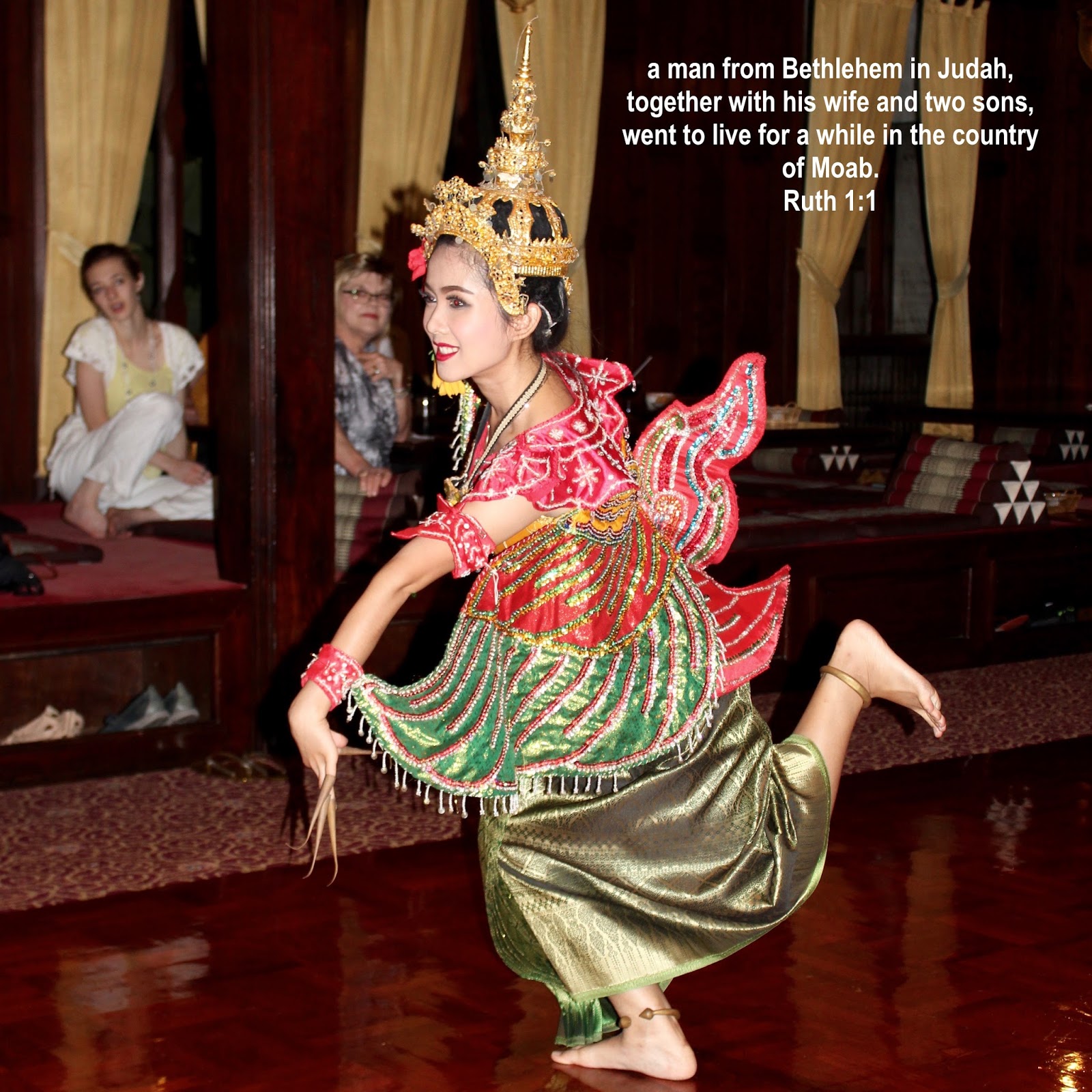
in the country of Moab.

The Moabites are descendants of Lot.  (Gen. 19:30-38)   Lot had settled in the wicked town of Sodom.  God decided to destroy the city, but upon the pleas of Lot's uncle, Abraham, two angles knocked on his door and escorted Lot, his wife and their two daughters from the city as God rained down fire on it.  The mom looked back at Sodom, the city she had built her life in.  Lot put his arms around his two daughters and blocked their view with his cloak, from the city as they left so that they would not turn to pillars of salt as their mother had.  They went up to the mountains, where Lot found a cave and settled there.  Eventually, the girls realized they would not be leaving to get married, so they slept with their dad to preserve the family line.  The older daughter had a son and named him Moab.  
Today, the country of Moab does not exist.  The area that used to be Moab, is now part of Jordan.  When I think of Jordan, I think of Queen Noor, the American woman who captured the heart of King Hussein of Jordan.  Queen Noor did much to promote the rights of women in Jordan.  The place of women in society was much the same during the time of Ruth that it was 50 years ago.  Women could not support themselves, they  had to rely on a husband or sons to take care of them.   Long before Queen Noor, a young woman left her hometown in Moab and became the grandmother of a long line of kings.
I also think of Petra.  Google a few images to get an idea of what the country looked like at that time. Petra was located just sound of the boarder of Moab in the desert.  Located on an important trade route, Petra became an oasis in the desert.  Roman columns carved into the surrounding hills sing a song of civilization amongst stark surroundings.  
Relations between Israel and Moab were tense, often filled with war.  Even today, Jordan and Israel have a "cold peace" between them.  During the time of Ruth though, there was a period of peace between the two nations.  Moab was an easy choice to move to because the languages were similar.  That would be a big plus for me!  Languages are not my thing, I find it so difficult moving every few years to a new country with a new language.  In a few short years, I only bother to learn a few essential phrases.  It makes my brain hurt just thinking about it!
The biggest difficulty with moving to Moab was not a language difference, or distance or culture.  Moab worshiped idols and God detests this.  Chemosh was the chief deity.  The people of Moab sacrificed humans to this god.  (2 Kings 3:27)  But he was not their only god.  They had temples and sacrificed to Baalim, or the sun god, as well.  (Numbers 25)  Taiwan is my first experience of living in a country that worships idols.  Churches in Colombia and Russia were filled with icons, but the foundation of their beliefs was Jesus Christ.  Here in Taipei, neighborhoods have temples.  Some are ornate and some are very plain, even tucked away between a few shops.  I know when I'm approaching one because the smell of incense grows stronger as I come closer.  Idols are sitting in rows in the dimly lit room.  Typically there is one large idol, surrounded by many small, doll-like ones.  A table sits at the entry filled with food people have brought to sacrifice to the idols.  Sometimes music is playing.  Often pieces are in a minor key feeling discordant and uncomfortable.  The instruments are unfamiliar, the sounds they produce pierce the air like a scream in the night.  I go in because I want to understand.  I've been taught to pray, while in the temples, for those who are around me, that they might find the one true light.  God does not want his people to become defiled by idols and sacrifices to false gods.  He wants them to remain pure.  This is the world that Ruth grew up in.  

Have you experienced extreme hunger, even fasted for a few days to understand the pain?
If you couldn't provide food for your family, what would you be willing to do?

Have you ever made a decision that you thought would only last for a little while, but then you found yourself trapped in a life you didn't want because of that decision?

Take some time to really think about the world that Ruth came from.  It is so very different from Western culture.  
Have you visited a country that worships idols?  
How did this make you feel?